
Gerrit Rietveld designed the chair underlying the Red Blue Chair in 1918. The familiar primary colour scheme was applied around 1923, linking the object closely with the Dutch De Stijl movement. Its construction consists of separate wooden rails and two inclined planes, one for the seat and one for the back, arranged as an open spatial composition.
The rails extend beyond their intersections so that their individual lengths remain apparent. Black members establish a framework, yellow ends mark selected terminals, and the red back and blue seat stand out as distinct surfaces. Colour clarifies how the components occupy space. The structure can therefore be read as a set of lines and planes as well as a usable armchair.
MoMA notes that Rietveld employed standard lumber sizes and sought a construction suitable for eventual mass production. The design also reflects De Stijl’s wider ambition to organize the environment through a coherent formal language. Furniture, painting and architecture shared this interest in relationships between verticals, horizontals and coloured surfaces. The chair condenses those relationships into an object encountered at the scale of the body.
 Rietveld Berlin chair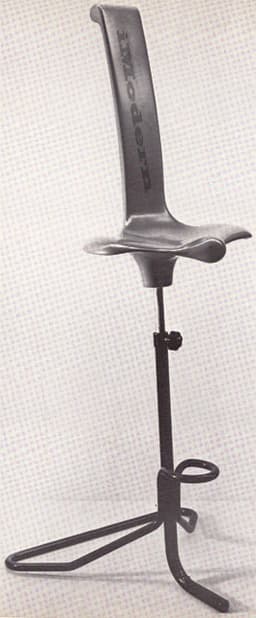

,_wood_-_Montreal_Museum_of_Fine_Arts_-_Montreal,_Canada_-_DSC08989.jpg)