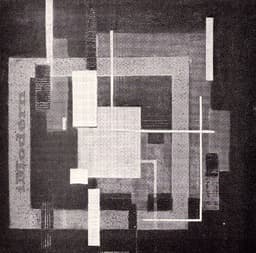
Theo van Doesburg made Counter-Composition VIII in 1924. The oil painting is held by the Art Institute of Chicago, where it entered as a gift of Peggy Guggenheim. Its square canvas is presented on a point, creating a diamond whose sloping edges frame an arrangement of horizontal and vertical divisions.
A broad dark form turns across the center, separating larger light areas from smaller sections near the perimeter. Because the internal divisions do not simply repeat the outline, the eye reads two geometries at once. Unequal areas produce an asymmetrical balance, and the meeting of a straight division with a sloping edge creates a pointed interval.
Van Doesburg founded the periodical De Stijl in 1917, giving its name to an associated group that included Piet Mondrian. Their interest in elemental forms reached beyond painting into architecture and design. This work offers a compact example of geometry operating without recognizable natural subjects: spacing, proportion, direction, and contrast carry the visual argument.
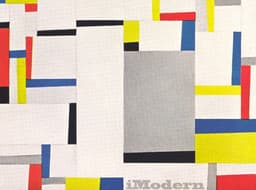
 Broadway Boogie Woogie by Piet Mondrian