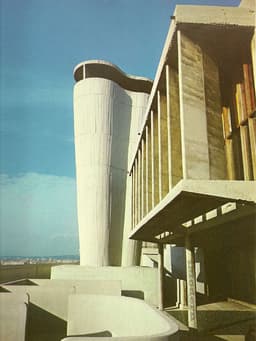
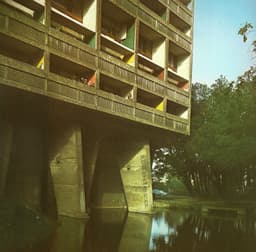
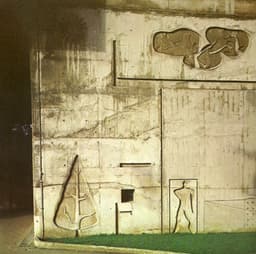
Le Corbusier did not lose his way, on the contrary, l'Unite at Marseilles strengthened his dogged faith in his own creed. He felt that here at last was proof of his basic arguments and, having obtained such proof, he could confront new hypotheses, confident offurther positive results.
He could now dedicate himself completely to developing the theme which had remained in a state oflatent potential because other objectives, more important at the time, had had to be fulfilled first. All the plastic energy, which for so long had been restricted by the dominance of rationalist thought, now burst forth with the impetus of liberation, accentuated by the flattery of the landscape in the 'espace indicible' of Ronchamp.
His fmal phase opens with and is characterised by Ronchamp; it was his most creative work in which many have wanted to find elements which betray an ideal or show a lapse of consistency.
But degeneration and survival do not feature in Le Corbusier's vocabulary, unlike other European masters of modern architecture; he is immune from that characteristic phenomenon of acquiescence which reduces avant-garde 'hopes' to the 'certainties' of a social and cultural conservativism altogether foreign to him.
Le Corbusier was always the standard-bearer of anti-conformity, consistency and courage. To the very last he remained the leading protagonist through his inexhaustible wealth of inventiveness, seen in his continuous experiments, the constant achievement of his own aims and that 'heretical habit, driving-force of all his artistic desires'.
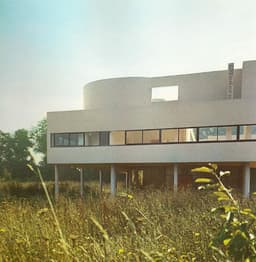
The architecture of Ronchamp seems to the author to be proof of a continuity of patient research, and above all of a plastic vocation. From his very earliest works, even the most stereometrical, the very severe structural arrangement is always softened by a lyrical vein in the contrasting plastic forms. One cannot deny that the roof-top of the Villa Savoye already has latent in it the first and not so timid plastic-formal 'turbulences'.
There are those who disregard the well-spaced, consistent progression which leads to the remarkable figurative results of the Plan-obus and l' Unite at Marseilles and consider these plastic tendencies destructive manifestations of manneristic formalism, superimposed on the context as though they were the outcome of a second, distracted moment of creation.
Such theses seem false arguments since one must remember the way in which Le Corbusier with equal intensity, had developed and elaborated formal themes alongside similar lines in both painting and sculpture. This was an extension of his search for interconnecting and modulated relationships.
The architecture of Ronchamp might be interpreted as the dominance and elevation of only one of the components which normally exist in Le Corbusier's poetry. However, this would not mean that the impetus towards plasticity finally destroyed or excluded the tight-knit background provided by a guiding rational process.
While form, as the result of method, becomes an important theme in his later works, it never has a moralising or pedagogic purpose, nor is it ever intended to show off anything which is not strictly in accord with human and natural situations and it is never there just for the sake of style.
 Le Corbusier Villa Savoye, Poissy