Designed for standing with some of the weight off one's legs in spaces too restricted for sitting, the Appoggio is anatomically shaped to correspond to the base of the pelvis.
Probably taking his cue from the bicycle seat, Salocchi applied a knowledge of anatomy to the stool and came up with a design to solve space problems in kitchens, news theatres, public transport and so on.
On some of these applications a fixed pole base plugged into the floor can be substituted for the free standing adjustable height arrangements shown. One interesting feature is the method of height adjustment which consists of a screw which tightens into a groove in the sliding rod. In order to prevent the seat from dropping if the screw should loosen, the groove is cut deeper towards the bottom so that the application of weight causes a wedging effect against the screw.
The height adjustment feature is important because unlike a chair the success of the Appoggio depends on its ability to match the length of a person's legs, the dimension of the human body which varies most from person to person.
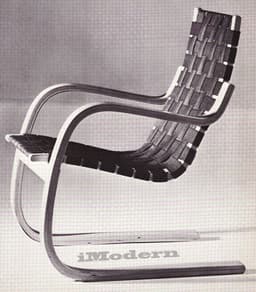
 Armchair by Aalto