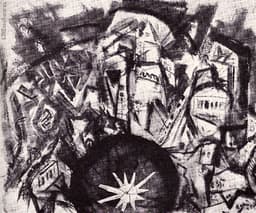
Vasily Kandinsky painted Improvisation No. 30 (Cannons) in 1913. The nearly square oil on canvas belongs to the Art Institute of Chicago. It comes from the period when his improvisations explored how painting could communicate through color and line while loosening their familiar ties to objects and recognizable scenes.
Dark strokes run through broad patches of blue, yellow, red, and pale green. Certain forms suggest buildings, a landscape, or artillery, particularly the wheeled shapes at the lower right. Yet the picture offers no stable viewpoint. Overlapping colors and restless diagonals keep those recognizable fragments suspended within a larger, unsettled arrangement.
In a letter to the Chicago collector Arthur Jerome Eddy, Kandinsky connected the cannons with contemporary talk of war. He nevertheless emphasized the viewer's response to the painting's colors and forms. This distinction makes the work useful beside Composition 8: both invite emotional readings of abstraction, while the earlier canvas retains more visible traces of the observed world.
 Composition 8 by Vasily Kandinsky