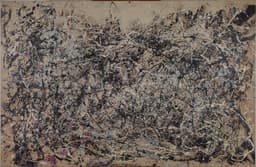
Jackson Pollock painted One: Number 31, 1950 during a period of intense activity in 1950. Measuring 269.5 by 530.8 centimeters, it is one of his largest canvases. The work combines oil and enamel paint and belongs to the Museum of Modern Art in New York.
Pollock worked with the canvas on the floor, moving around its edges and pouring, dripping, or flicking paint onto the surface. The resulting lines record changes in speed, direction, and the flow of liquid paint. Dense black and white passages cross quieter areas of tan, blue, and gray. Differences between matte and glossy paint add another layer to the surface.
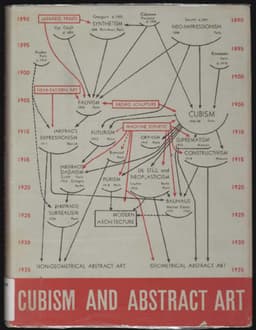
The composition has no single point around which everything is arranged. Instead, overlapping loops and splashes distribute attention across its broad expanse. The effect can seem forceful at a distance and surprisingly delicate when individual strands are examined. MoMA relates Pollock's experiments with chance to Surrealism, while also emphasizing the order within the finished painting. The work offers a useful counterpart to geometric abstraction: its structure grows through accumulated gestures.
 Modern Art, Abstract Art and Contemporary Art