
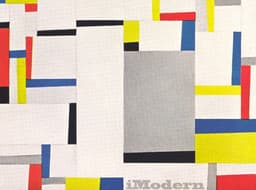
Piet Mondrian painted Broadway Boogie Woogie in New York in 1942–43. The oil painting measures 127 by 127 centimeters and belongs to the Museum of Modern Art. Its square canvas is crossed by yellow bands, punctuated with small rectangles of red, blue, gray, and white.
Mondrian had arrived in New York in 1940, and his enthusiasm for the city and boogie-woogie music informed the painting. His earlier approach to abstraction restricted the composition to horizontal and vertical lines and a limited palette. Here he removed black and divided the lines into changing sequences of color. The intersections seem to interrupt and restart the movement of the eye.
The painting can be read as a balance between a fixed framework and an irregular beat. Larger blocks of color settle within the grid while smaller ones keep it active. The connection with streets and music remains suggestive: the canvas describes neither a particular view nor a musical score. Within the archive's geometric art, it offers an example of how strict formal limits can produce considerable variety.



.jpg)