Sony introduced the TPS-L2 Walkman in 1979. The company’s history describes its origin in co-founder Masaru Ibuka’s wish to hear stereo music while travelling by air. A monaural recorder was adapted for stereo playback, helping establish the idea of a compact player used with lightweight headphones. The absence of a recording function was a deliberate part of the original product.
The blue and silver casing concentrates a surprising number of functions into a narrow body. A window reveals the cassette inside, the transport controls line up along the side, and the two headphone sockets are grouped across the top. Differences in color, texture, and position help separate controls that otherwise occupy very little space.
The TPS-L2 extends the archive’s portable-radio story into personal cassette listening. A radio receives a broadcast selected through its tuning control; the Walkman carries a chosen recording. The comparison makes clear how the design of a small enclosure could support a different relationship between movement, music, and its listener.
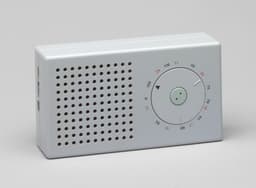
 Braun T3 pocket radio