Vladimir Tatlin was a leader of the Russian Constructivist movement, and the Tatlin is the only existing chair from this period.
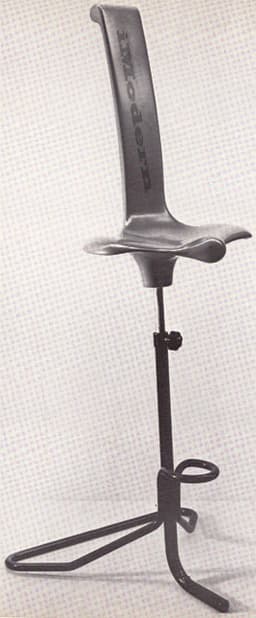
The example shown here is believed to be the only production model since Tatlin's own prototype. It differs from the original in that the frame has been made in steel instead of bent wood, because of the apparent impossibility of producing a wood frame of sufficient soundness.
Tatlin was deeply involved in the making of flying machines. He created great winged forms made out of literally bentwood skeletons, covered in canvas and occasionally reinforced with whalebone. His structures stretched the tensile and loadbearing capacities of the wood to the utmost, and clearly this chair is an adaptation of the principle learnt for these primitive exercises in aerodynamics - the flow of stress through load-bearing members from tight grouping to a wide splay.
In the bentwood prototype, the points where the lines met - on the ground and half way up the back - were bound with cane. In the present model there are single screws visible at each of these points. The only other change from the original structure is the tightening of the curve where the back leg tube leaves the floor. This makes the legs more vertical and considerably less graceful.
The seat is a quite distinct unit, placed within the structural web of this linear chair. It is a modified tractor saddle with contoured padding and an intricately tailored leather covering, and is beautiful in its own right. This remains a most elegant chair, and hows no sign of looking dated after the almost half century between conception and production, though the present model is not quite the graceful, swooping, organic form that Tatlin originally designed.
The original Tatlin chair, made in the same way that Tatlin built his flying contraptions, with bent wood, bound by split cane, supporting a simple seat element.
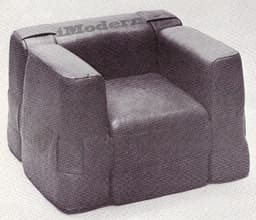
 Tomeraj armchair