The Zigzag chair is a stark assertion of function - a platform and support for the seated human frame.
The reduction of the structure to four unobstructed and unadorned planes has engendered a whole range of new thoughts and possibilities, taken up by later designers, for the distribution of load-bearing members and the absorbtion of stress.
The formal quality of the object itself has also been profoundly influential. To design a chair after coming in contact with the Zig-zag, one is in a way forced to start from a new point of departure, with a new initial premise, and to consider each line, plane, support or elaboration of chair structure using much more stringent criteria.
Rietveld's intention was to make a one-piece chair, but he was defeated by the material.
Verner Panton's stacking chair has been compared to the Zig-zag, and it is clear that it embodied Rietveld's intention, though in a rather more relaxed form. Rietveld also intended the chair to use a minimum of room space. Though it is very arresting in isolation, the chair mixes surprisingly well with other furnishings.
The Zig-zag is a small chair, and it appears poised, almost as if alert to its task, and ready to receive one's weight. One can demonstrate the chair's strength by standing on the back edge, and though he may wobble, the chair will not shift.
Although the construction is of extreme simplicity, the wood itself needs very specialized treatment. It is important that the beech wood be well seasoned, or the chair will be distorted quickly by warping: and this is especially ruinous if the foot becomes curved.
In making this chair of hardwood, only dovetail joints are necessary, but in softwood these must be reinforced with a batten and bolts. The chair has a small hand-hold slot cut out of the back - a pleasing detail in such a stark design.
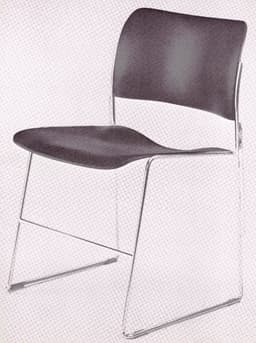
 Rowland Stacking Chair